

Ground Reaction Force in Lifting Shoes and How It Works
A lifting shoe can change how force is transmitted at the foot-floor interface, but it doesn’t create extra force by itself. The ground reaction force in lifting shoes reflects the interaction between the lifter and the floor. In one conventional deadlift comparison, peak force was 989.7 newtons in shoes and 993.9 newtons barefoot, with no significant footwear effect.
It’s easy to assume a more stable shoe must produce a higher force reading. The key is to distinguish the force itself from how your foot applies it, including braking and propulsion, pressure shifts, and the shoe’s role in supporting your position.
This guide explains how ground reaction force relates to Newton’s third law, what the center of pressure indicates, and how force platforms measure forces in three dimensions. You’ll also learn what footwear studies can reveal about lifting, and where their findings have limits. Understand the mechanics, then make a better-informed choice about the shoes you train in.
Key Takeaways
- Read force-platform results as a three-dimensional picture of force, not a single score for shoe performance.
- Separate braking from propulsion to understand how force shifts as the foot interacts with the floor.
- Use the center of pressure to interpret where force acts beneath the foot and how that relates to joint loading.
- Apply Newton’s third law to understand why the ground pushes back, while remembering that footwear can affect force application without creating force.
Study design, measurement methods, and limitations
A force platform measures the force exchanged between the body and the floor. It can record ground reaction force in three dimensions, including its vertical component. During a lift, the readings show how force changes while the feet remain in contact with the platform. Researchers can compare shoe conditions, but the platform measures force, not why the lifter produced it.
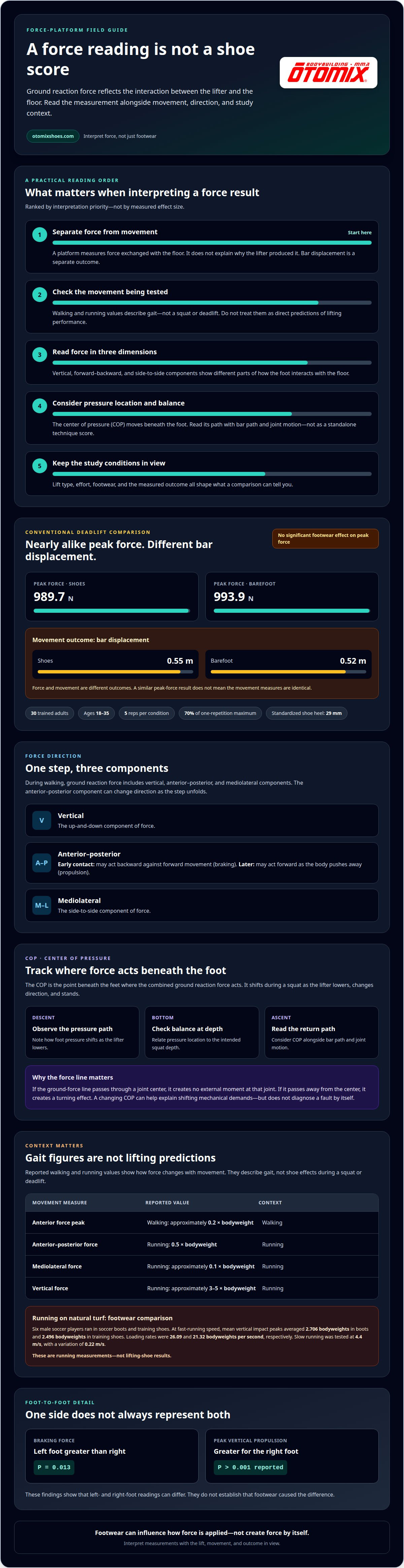
One deadlift study tested 30 trained adults aged 18-35 years. Participants completed five repetitions per condition at 70% of their one-repetition maximum. The standardized shoes had a 29-millimeter heel. In conventional deadlifts, peak force measured 989.7 newtons in shoes and 993.9 newtons barefoot, with no significant footwear effect. Yet bar displacement differed: 0.55 meters in shoes and 0.52 meters barefoot. That result shows why force and movement outcomes need separate interpretation.
Natural-turf measurements offer another useful comparison, but involve running rather than lifting. Six male soccer players ran in soccer boots and training shoes. At fast-running speed, mean vertical impact peaks averaged 2.706 bodyweights in boots and 2.496 bodyweights in training shoes. Their corresponding loading rates were 26.09 and 21.32 bodyweights per second. Slow running was tested at 4.4 meters per second, with a variation of 0.22 meters per second. These results describe footwear under running conditions, not a lifting shoe’s effect during a squat or deadlift.
Are weightlifting shoes beneficial for beginners or lifters with limited ankle mobility? A raised heel can help a lifter reach a more upright squat position when ankle movement is limited. Beginners still need to develop balance, bracing, and consistent technique. Shoes don’t teach those skills.
What are the risks or drawbacks of lifting shoes for performance and joint loading? A raised heel changes foot position and may affect balance or pressure distribution, so a shoe may not feel suitable for a particular lift. Force-platform readings alone don’t show whether joint loading is better or worse. Technique, lift type, and the outcome being measured all matter.
Braking and propulsion forces
Ground reaction force during walking has vertical, anterior-posterior, and mediolateral components. The anterior-posterior component changes direction across a step. Early in contact, it can act backward against forward movement, creating braking. Later, it can act forward as the body pushes away. These phases describe force direction, not separate forces generated by footwear. A shoe may affect how the foot meets the floor, but the reading also depends on movement and effort.
Walking and running show why speed and distance matter when interpreting results. During walking, the anterior ground reaction force peak is approximately 0.2 times bodyweight. During running, reported anterior-posterior force reaches 0.5 times bodyweight, while the mediolateral component is approximately 0.1 times bodyweight. The vertical running component is approximately 3 to 5 times bodyweight. These gait values describe sports movement, not a deadlift or squat. Don’t use them as direct predictions of lifting performance.
Foot-to-foot differences can also appear in force measurements. In one comparison, left-foot braking force was greater than right-foot braking force, with P = 0.013. Peak vertical propulsion forces were greater for the right foot, with P > 0.001 reported. Those findings show why measurements from one side shouldn’t automatically represent both feet. They also don’t establish that footwear caused the difference.
For a lifter, the useful distinction is whether force is directed to resist movement or drive it. A deadlift begins with the bar moving upward, while a controlled descent involves resisting downward movement. Footwear may influence contact and balance, but a force value alone can’t explain technique or performance. Consider shoe design alongside the lift and the movement being measured. For a footwear option focused on weightlifting, explore weightlifting workout shoes as part of that decision.
Center of pressure
The center of pressure (COP) marks where the combined ground force acts beneath the foot. In a squat, its location helps explain how foot pressure relates to balance and the movement’s mechanical demands.
Center-of-Pressure Concepts
The COP is the point beneath the feet where the ground reaction force acts. It isn’t fixed: during a squat, pressure can shift as the lifter lowers, changes direction, and stands. Tracking that path provides more information than a single force reading. It connects foot contact with balance without treating pressure location as a complete measure of technique.
Joint position matters, too. If the ground reaction force’s line of action passes through a joint center, it generates no external moment at that joint. If the line passes away from the center, it creates a turning effect. For example, a COP path that changes in relation to the knee can help explain how mechanical demands shift through a squat. On its own, it doesn’t diagnose a fault.
Heel Height and Squat Mechanics
A raised heel changes the foot’s starting angle and can allow more forward knee travel while the torso stays more upright. This may help a lifter reach depth when ankle movement is limited, but it also changes how the lifter balances over the foot.
Compare the COP during the descent, at the bottom, and through the ascent. If pressure shifts toward the toes or heels, the lifter may adjust trunk position or balance to keep the bar moving. The same heel height won’t produce identical mechanics for every lifter: stance, mobility, and squat style all influence the result. Read COP alongside bar path and joint motion, not as a standalone score.
Use the measurement to ask a focused question: does the pressure path stay controlled as the lifter reaches the intended depth? A COP trace that moves during a rep isn’t automatically a problem. Its meaning depends on how the force line relates to the ankle, knee, and hip. In practice, shoe choice matters when the heel changes the position from which the lifter controls each squat phase.
Ground reaction force and Newton’s third law
Newton’s third law says the floor pushes back with force when your feet push against it. During a lift, the measured response reflects both your effort and how your body moves.
Peak Vertical Force Comparisons
Peak vertical force is the greatest upward force measured through the feet during a lift. A lifting shoe doesn’t automatically produce a higher peak than a flat shoe. In a deadlift comparison, footwear did not significantly affect peak force between shod and barefoot conditions. That finding doesn’t establish a ranking against flat shoes or prove that every lifter responds the same way.
Left-Right Force Differences
Left-right force difference describes how much each leg contributes during the same movement. Shoes don’t automatically equalize force between legs. A lifter may shift pressure because of stance, bar position, or movement strategy, even in matching shoes. Compare both sides during the same phase of a lift: one peak can hide when an imbalance appears or changes.
Forces Across Lifting Styles
Force patterns vary with the lift, so Olympic lifts and powerlifting movements shouldn’t be treated as identical tests. A snatch or clean includes a rapid pull and catch; a squat or deadlift follows a different movement pattern. Those actions change how force is directed and timed. Interpret shoe effects for the specific lift rather than generalizing across strength sports.
Footwear Comparisons for Ground Reaction Force
A footwear comparison measures force under different conditions, such as lifting shoes, barefoot, running shoes, or flat-soled shoes. The deadlift comparison above found no significant footwear effect between shoes and barefoot, but it doesn’t settle comparisons with running or flat-soled shoes. Sole structure can change foot position and contact; force measurements still reflect the lifter’s movement and effort.
Choose footwear for the lift and the position you need to control, not an assumed force boost. Explore weightlifting footwear options for your training.
Otomix
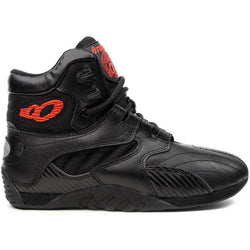
Otomix offers lifters several footwear options to consider without assuming a shoe will change their force output. The range includes Stingray Performance Bodybuilding Weightlifting Workout Gym Shoes, Ultimate Trainer Bodybuilding Weightlifting Workout Gym Shoes, and Extreme Trainer.
Use the concepts in this guide to focus your decision: the lift you perform, the foot position you can control, and the balance you need through each phase. Ground reaction force readings don’t identify one universally best shoe. They show how force behaves in a specific movement and test condition. Choose footwear for your training demands, rather than expecting it to create extra force.
If you’re weighing these options for your lifting routine, contact Otomix to discuss the footwear choices.
Take Your Next Lift With a Clearer Plan
In your next training session, focus on the position you can control rather than a force number in isolation. Notice whether your feet stay planted, how your balance shifts, and whether your setup supports the lift you’re performing. These observations can help you decide what matters most in footwear.
Ground reaction force in lifting shoes is best understood as part of your movement, not as a score a shoe can guarantee. Choose with your training priorities in mind, then build consistency through deliberate practice. Strong decisions start with clear mechanics.
Ready to consider footwear for your routine? Contact Otomix about lifting shoes, and take your next training step with confidence.
Frequently Asked Questions
What is ground reaction force in weightlifting?
It’s the force the floor exerts on a lifter’s feet as they push against it. During a squat, for example, the floor’s response acts upward while the lifter moves the bar and body. Ground reaction force in lifting shoes describes this same interaction with footwear on. It doesn’t mean the shoes generate force: the lifter’s actions and contact with the floor create the exchange.
How do weightlifting shoes affect ground reaction force during a squat or clean?
Weightlifting shoes can change the foot position for a squat or the catch of a clean, but they don’t guarantee a higher force reading. In a clean, the receiving position involves absorbing and controlling motion as the bar is caught. Consider whether the footwear supports a balanced, repeatable stance for that phase. A change in posture or timing can influence a measurement without proving that the shoe itself increased force.
What studies measure ground reaction force in weightlifting shoes?
Controlled footwear studies use force platforms during a defined lift to record how force changes over time. Strong comparisons keep the movement, load, and measurement setup consistent, then assess the force curve rather than relying on a single peak. Results from a deadlift test don’t establish what happens in a clean or squat. The lift studied matters when applying the findings to your own training.


