

Heel Elevated Squat Mechanics: How Raising Your Heels Changes Your Form
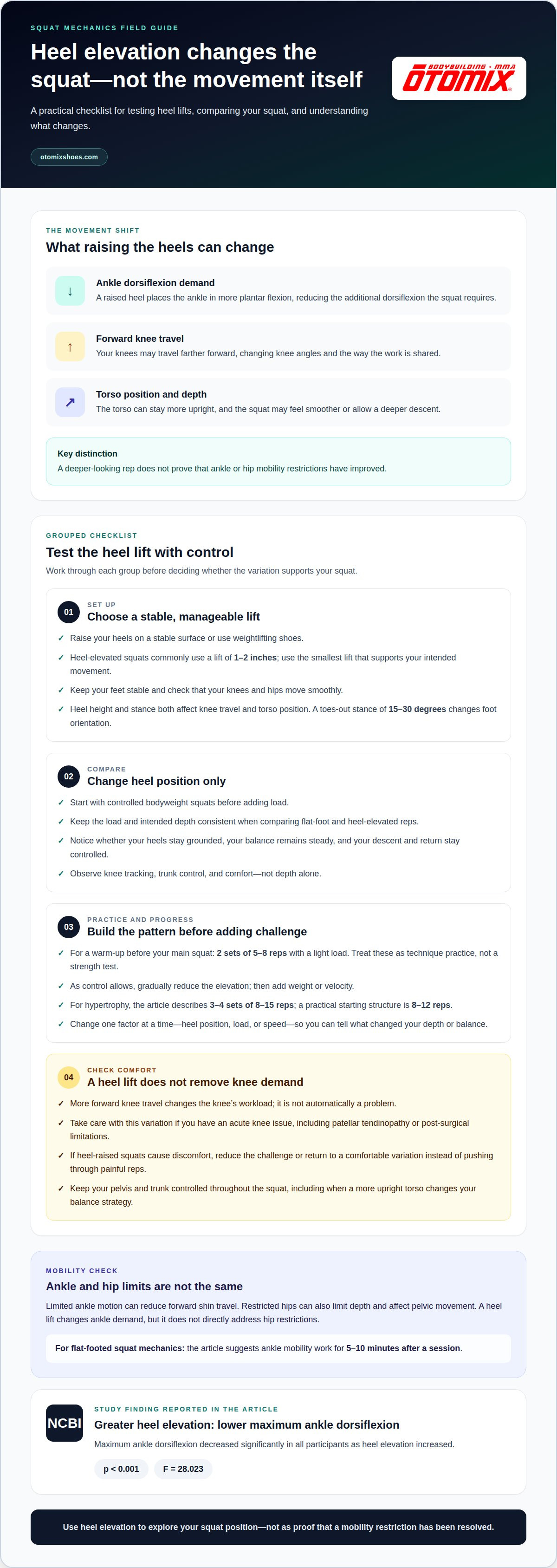
A heel lift can change your squat without changing the movement itself. Understanding how heel elevation affects squat mechanics starts with the ankle: raising your heels reduces the dorsiflexion your ankles need, which can let your knees travel farther forward and your torso stay more upright. Heel-elevated squats commonly use a lift of 1-2 inches.
If ankle mobility limits your squat depth, raising your heels can make the movement feel smoother and help you descend farther. But a deeper-looking rep doesn’t mean the underlying restriction has improved. Heel elevation can also change how your knees, hips, and lower back share the work, so its effect depends on your movement and training goals.
Learn what counts as a heel-elevated squat, how it changes ankle demand and range of motion, and what those changes may mean for your knees and lower back. Then you can decide whether heel elevation supports your squat goals or simply helps you work around a limitation.
Key Takeaways
- Heel elevation can reduce the ankle mobility a squat demands, changing how far your knees travel and how upright your torso stays.
- Consider how the altered knee and hip positions affect your squat, especially if you have knee discomfort or are managing a lower-back concern.
- Use a heel lift as a way to explore squat depth, not as proof that mobility restrictions have been resolved.
- Explore Otomix weightlifting and gym shoes when you’re considering footwear for your training setup.
How heel elevation changes ankle dorsiflexion demand
Raising your heels reduces the ankle dorsiflexion needed to squat, which can help you descend farther while keeping your heels grounded. Heel height and stance also affect knee travel and torso position. Understanding how heel elevation affects squat mechanics helps you interpret what changes during each rep.
Ankle Dorsiflexion Demand
Ankle dorsiflexion is the forward bend at the ankle as your shin moves over your foot during a squat. Elevating your heel places the ankle in more plantar flexion, reducing how much additional dorsiflexion the movement requires. This can matter if limited ankle motion makes you lift your heels or lean forward to descend.
In a study reported by the National Center for Biotechnology Information (NCBI), maximum ankle dorsiflexion decreased significantly in all participants as heel elevation increased (p < 0.001, F = 28.023). The finding shows how changing heel height can alter ankle movement during a squat, even when the lifter’s basic task stays the same.
Ankle and Hip Mobility Limits
Ankle and hip mobility limits can both restrict squat depth, but they affect different parts of the movement. Tight calves or limited ankle-joint mobility can reduce forward shin travel; restricted hips can also limit depth and affect pelvic movement. A heel lift changes ankle demand, but it doesn’t directly address hip restrictions.
Compare the movement pattern, not depth alone. If the squat changes with raised heels, ankle mobility may be one factor; persistent restriction can involve the hips or reduced foot engagement. For flat-footed squat mechanics, ankle mobility work for 5-10 minutes after a session is one suggested option.
Heel Height and Stance Effects
Heel height and foot angle influence how the knees and torso move through a squat. Increasing the heel lift changes ankle demand, while a stance with toes turned out 15-30 degrees changes foot orientation. To assess how heel elevation affects squat mechanics, observe balance and control as you adjust these positions.
Use the smallest lift that supports your intended movement. A heel-elevated position may allow greater knee flexion, but it doesn’t show that ankle or posterior-chain mobility has improved. Compare squats with and without the lift, noting whether your heels stay grounded and your movement remains controlled.
Potential knee and lumbar loading concerns
Heel elevation can increase forward knee travel, changing joint angles and force distribution. Compare flat-foot and heel-elevated squats using controlled bodyweight reps before adding load.
Knee Travel and Torso Position
Knee travel describes how far your knees move forward as your hips descend; torso position describes how much your trunk inclines. With raised heels, your knees can move farther forward while your torso stays more upright. This changes your balance and shifts muscle demands toward the front of your legs.
More forward knee travel isn’t automatically a problem, but it changes the knee’s workload. If you have an acute knee issue, such as patellar tendinopathy or post-surgical limitations, take care with this variation. Notice how the movement feels and whether you can control the descent and return to standing.
Knee Shear Forces
Anterior tibial shear force is a forward-directed force acting on the shin at the knee. Heel elevation can increase this force by changing the squat angle and encouraging greater knee travel. The knee therefore experiences a different loading pattern, even if your stance and external load stay the same.
Joint stress depends on the whole movement, including depth, control, and load. Don’t treat a heel lift as a way to remove knee demand. If heel-raised squats cause discomfort, reduce the challenge or return to a comfortable variation instead of pushing through painful reps.
Your lower back also responds to how your hips and torso move. If spinal movement is restricted, you may need more horizontal hip movement to maintain balance. A more upright torso can change that balance strategy, but you still need to control your pelvis and trunk throughout the squat.
To make a useful comparison, keep the load and intended depth consistent while changing only your heel position. Start with bodyweight, descend under control, and notice any changes in knee tracking, trunk control, or comfort. Then consider whether the lift supports your training goal or shifts more demand toward your knees.
What is a Heel Elevated Squat?
A heel-elevated squat is performed with the heels raised on a stable surface or in weightlifting shoes. The lift changes your ankles’ starting position, giving the movement a different balance and range-of-motion profile. You can use it as a warm-up variation, a strength exercise, or a way to practice deeper squats.
Test the position during warmups with bodyweight squats. Keep each rep controlled and check whether your feet stay stable and your knees and hips move smoothly. A heel lift should support the movement you intend to train, not force you into a deeper position you can’t control.
For a warm-up before your main squat, use two sets of 5-8 reps with a light load. Treat these reps as technique practice, not a strength test. Once you can maintain joint range of motion with your heels on the ground, gradually reduce the elevation. Then add weight or velocity as your control allows.
Strength training calls for deliberate progression. Keep your squat pattern consistent as you adjust the lift, load, or speed. Change one factor at a time so you can tell whether changes in depth or balance come from heel position or heavier load.
For hypertrophy, heel-elevated squats can be programmed for 3-4 sets of 8-15 reps. A practical starting structure is 8 to 12 reps, with each set focused on controlled movement and the target range of motion. Greater effort should come from the muscles doing the work, not from losing balance.
Beginners can build comfort with a heel-elevated goblet squat for 4-6 weeks before moving to a barbell variation. The goblet hold offers a clear way to practice the squat pattern with a manageable load. Progress when you can repeat the movement with control, rather than advancing simply because the calendar says it’s time.
Heel elevation as a way to regain range of motion
A heel lift can make a deeper squat accessible while you work on restricted movement, but it doesn’t automatically restore mobility. Heel-elevated goblet squats can help you practice through a larger range if restrictions around your pelvis or spine limit your descent.
Use the variation to explore your movement, not as proof that tightness has changed. For example, if raising your heels lets you descend while maintaining balance, compare that pattern with a flat-foot squat over time. Reassess regularly. A heel lift can improve how a squat looks while masking muscle tightness, so track whether your range remains when you reduce the support.
Keep the training goal clear. If your aim is to rebuild a flat-foot squat, pair heel-elevated practice with mobility work and revisit the unraised version regularly. A moderate heel elevation of around 20-25 mm can support squat mechanics while changing joint stress. Gradually reducing the lift lets you see whether your ankles, hips, and trunk can manage more of the movement without it.
Range also depends on what you ask the squat to do. A descent around 90 degrees is cited as necessary for maximal glute contraction, but depth alone doesn’t tell you whether the movement is controlled. Keep your feet grounded, maintain balance, and notice whether your pelvis or lower back changes position as you descend.
Use a heel-elevated goblet squat as a practice variation, then reassess your movement without the lift. If your descent stays smooth and controlled with less elevation, you’re demonstrating more available range in that squat pattern. If the difference disappears when you remove the lift, treat the elevated version as support, not proof that mobility has been restored.
Choose footwear that suits your strength-training setup as you refine your squat practice. Explore weightlifting footwear for your training.
Otomix
Otomix offers footwear for bodybuilding, weightlifting, and gym workouts, giving you options to consider as you build a consistent squat setup. Heel elevation changes the movement; footwear is one part of your setup, not a substitute for ankle or hip mobility work.
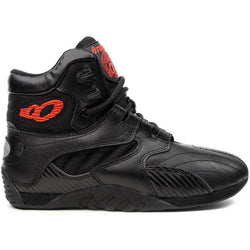
Consider the Stingray Performance Bodybuilding Weightlifting Workout Gym Shoes, Ultimate Trainer Bodybuilding Weightlifting Workout Gym Shoes, and Extreme Trainer as you choose footwear for training. Select your squat variation based on the movement you’re practicing and the range you can control. Your shoes alone don’t determine whether raised-heel or flat-foot squats suit your needs.
Contact Otomix with questions about its footwear and your weightlifting setup.
Make Your Next Squat Session More Intentional
Turn your observations into a clear training choice. Decide whether your next block prioritizes practicing a comfortable squat pattern, building strength, or gradually relying less on heel support. Keep your goal consistent across sessions and note how your setup feels as you train. This gives you a useful basis for deciding what to keep and what to adjust.
Understanding how heel elevation affects squat mechanics is one part of that decision. Your footwear should suit the demands of weightlifting and gym training, but it isn’t a fix for mobility limitations. Otomix offers the Stingray Performance Bodybuilding Weightlifting Workout Gym Shoes, Ultimate Trainer Bodybuilding Weightlifting Workout Gym Shoes, and Extreme Trainer.
Have questions about footwear for your training setup? Contact Otomix and keep building a squat routine that matches your goals.
Frequently Asked Questions
How does heel elevation change squat depth and ankle dorsiflexion?
Heel elevation can make a deeper squat easier by reducing the ankle’s required forward bend. This may help if your heels rise or your descent stalls, but it doesn’t explain why your ankle motion feels limited. To assess how heel elevation affects squat mechanics, notice whether you reach depth with steady balance and controlled movement, rather than judging the rep by depth alone.
How does heel elevation affect knee travel, knee flexion, and joint loading during squats?
Raising your heels can allow more forward knee travel and knee bend, changing the forces your knee manages. The effect also depends on squat depth, external load, and control. For example, a bodyweight rep may feel different from a loaded set with the same stance. If your knee is uncomfortable, pay attention to how the altered position feels instead of assuming more knee travel is always better or worse.
How does heel elevation affect hip flexion, torso angle, and trunk position in a squat?
Heel elevation can accompany a more upright torso, while hip flexion describes your thigh moving toward your trunk. These positions are related, but torso angle alone doesn’t show how your hips or pelvis are moving. As you descend, observe whether your trunk and pelvis stay controlled. Movement quality offers more useful information than forcing a particular torso angle.
What does research show about heel-elevated versus flat-foot squats for muscle activation?
A 2022 study in the Journal of Human Kinetics found greater vastus lateralis and rectus femoris activation during heel-elevated squats than flat-footed squats. Another 2022 study in the Journal of Strength and Conditioning Research reported higher vastus lateralis activation in exercises emphasizing knee flexion and forward knee travel than in hip-dominant variations. Muscle activation findings don’t guarantee a specific strength or growth result.
What are the differences between weightlifting shoes, heel wedges, and plates for elevating the heels?
Weightlifting shoes build heel elevation into the footwear; wedges and plates are separate supports placed under the heels. Squat setups may use a wedge, a 2x4 board, small weight plates, or bumper plates. Each option changes how the lift is provided, but a stable base still matters. Choose a setup that lets you keep your feet secure through the full repetition.
What heel height is recommended for squatting, and how should it be chosen?
There isn’t one heel height that suits every squat; weightlifting shoes commonly have a heel height around 0.75 to 1 inch. Consider how heel elevation affects squat mechanics for your own stance, balance, and training goal. Test the movement with a manageable load and choose an elevation that supports controlled depth. If you’re working toward a flat-foot squat, reassess your movement without the lift over time.


